This is my way of wishing all a lovely holiday season, with good thoughts spilling into the New Year. From our house to yours.
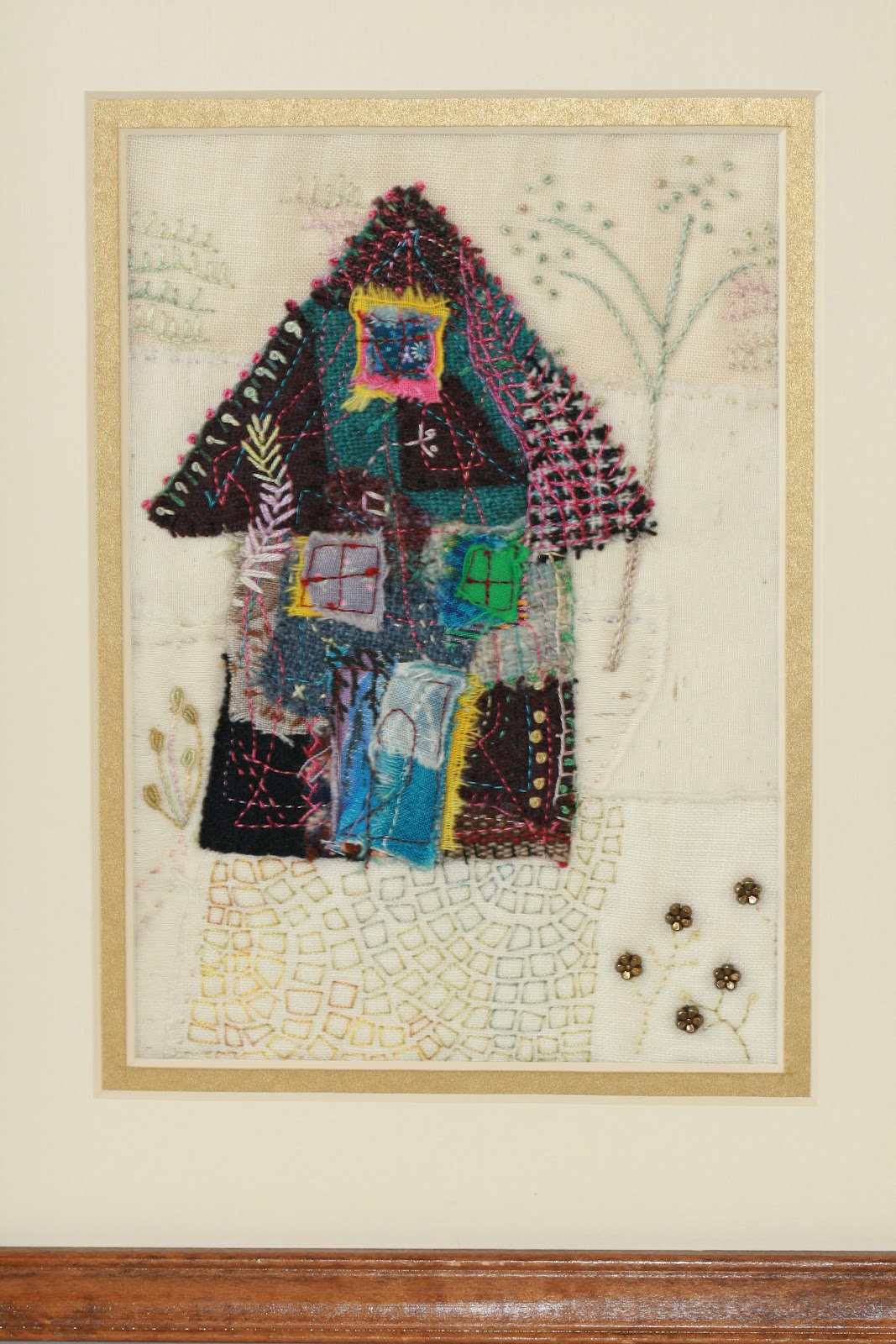
This is my way of wishing all a lovely holiday season, with good thoughts spilling into the New Year. From our house to yours.


Now that you have spent some time in hunter-gatherer mode, sampling as you compiled your new assortment of thread and yarn, let's look at some of the marks you can make with them.
Lines in Running Stitch can divide areas from one another, lead the eye forward, curl and swirl to bring up images of winds and skies or seas and moving water. The dip and rise of land or contour drawings can be conveyed with these simple stitches.

In a more complex line, the stitches should be quite close to one another, even touching or overlapping. A curving or spiraling shape will bend with more grace when the stitches almost intersect, giving a sinuous character to the lines.
Other Straight Stitch suggestions for making curling marks are Back Stitch and Outline Stitch, which are opposites of one another. Turn your fabric over and see where the Outline Stitches you made on the front of the fabric are Back Stitches on the reverse.
In Back Stitch it is easy to make a continuous line by having the stitches share the same entrance and exit points. This is useful when drawing shapes to be filled or making lines around something we should not miss in the story.

Backstitch is also a very strong stitch, if you are reinforcing or connecting two pieces of cloth. In the sample below, I have used some backstitched lines to strengthen the top of the cloth, but the stitches do not share the same entry/exit points as in the grid above. They are spaced so the lines resemble running stitch. Without heavy stitching, raw edges often curl or continue raveling, so the camouflaged Back Stitch is both utilitarian and decorative here.

In Outline Stitch a part of one stitch overlaps slightly a portion of the previous stitch, so that a line has an almost doubled feeling to it.
Outline Stitch also has the ability to make rough, choppy lines by moving them slightly out of alignment. The resulting marks are very painterly, much like a quickly drawn sketch. The lines can reinforce the movement of a line and give energy to the object or area being stitched. It is more like drawing with a needle than simply stitching.

In contrast, Straight Stitch marks made of different sizes and with more space between them may suggest awkwardness or indecision. If the thread is very heavy, however, the space between the stitches becomes a useful breathing space, where we can see the pinching of the chunky thread through the tiny hole in the fabric changing the shape of the mark from flat to oval with slightly pointed ends. There are several examples of chunky thread and torn strips of silk fabric in the wave below:

In the example below, the single curving line of Running Stitch skips and moves about, but a second line has been added to help to smooth out the curve. Though it seems abrupt in places, the doubling of the line maintains a gentle flow as the line escapes the yellow silk block.

In combination with appliqué, dyes, and rusted fabrics, this look at a stretch of the Appalachian Mountains has been stitched in straight stitches. The threads are a mix of over-dyed weaving threads in several different weights and textures, then stitched as tilted and curving lines and blocks to follow the contours of the land:

As an exercise, try making as many curving lines as you can with Running Stitch, Back Stitch, and Outline Stitch. Vary the threads as you work. Each of the three stitches has its own characteristics that can be explored and developed in your personal style.
I have been thinking about stitches lately, about the way I use them, why I make the decisions I do, and what goes into making some pieces more successful than others. Stitch is only part of it, but if stitch is my drawing tool, it is also the way I get into the design and layout of the story that I'm telling. Sometimes the story is abstract and even vague, maybe it is more a poem or a haiku in stitch. Whatever the subject or form, it starts with a stitch and a color choice.

This will be a lot of blog-musing, but if you'd like to follow along, I'm glad to have you. I will try to post on the subject of straight stitches every week or so, but the Universe has a habit of hurling things my way, and the Universe can often be unsympathetic to personal deadlines. What follows is a view of my personal observations on the straight stitch and its family.
A note: I tend to stab-stitch rather than "sew" through the cloth, and because stab-stitching can be hard to follow, I don't give any directions on how to make the stitches. There are an overwhelming number of videos on line that you might use, if you don't have a fairly comprehensive stitch dictionary at hand. I recommend Mary Corbet's videos for her clear instructions of traditional methods of stitch.
Straight stitches are flat, one-stroke marks on a cloth. They may combine with other straight stitches to make zig-zag, arrowhead or fern stitch, but they are still one-stroke marks. This is a sampler I have used as an index of straight stitch ideas, a way of remembering possibilities I might so easily overlook (or forget):

The simplest of all stitches, the stitch even children immediately understand, the straight stitch can be the most expressive way to put ideas to cloth with needle and thread. The reason is in its straight forward simplicity. The straight stitch does not use loops, knots, or combinations of marks to make itself felt. It is a mark that directs our attention by its size, thickness or thinness, texture, or color. It is in the choices the stitcher makes that determine the character of this stitch.
The size of the thread we choose, thick or thin, is a way of showing emphasis, expressing strength or weakness, or of pulling things from back to foreground. Satin stitch worked in two or three strands of cotton, silk or rayon floss creates an unblemished surface of calm, while to use a larger needle and slightly textured thread, like wool, linen or threads manufactured/spun for hand weaving or knitting, that unblemished and calm surface can become a less placid scape, and possibly more interesting.
This is not to say that the chains, loops, composites and knots are not beautiful and useful. But when a piece uses a multitude of stitches, the stitches by weight of their number and variety begin to become items of interest, and our attention is drawn away from the message in the piece and to its individual components. A piece stitched with an assortment of highly decorative stitches might drift into looking more like a beautifully stitched sampler than a story. Just because we know (and love) these beautiful stitches does not mean we have to use them all in one project. To tell a story simply, a simple stitch may do a cleaner, more easily understood job of it.

Color may be the most eye-catching component of a piece. There are so many differently variegated threads that listing all the combinations would be a never-ending exercise. Some can be so variously colored that they are difficult to use. The more useful ones for me and my practice are threads in variations of themselves, such as shades or tints of yellow-green or watery blues, or reds that move toward orange but don’t completely give themselves to that overpowering color. Color is a very personal subject, and you will always set your own colorways to suit the story your are stitching.
Thread colors can also be mixed in the needle for a more interesting color palette. As your stitching progresses with this combination of colors, the threads will twist, and in a mix of three differently-colored strands, the colors will take turns appearing topmost on the cloth.

Of more interest, if you look to add texture to an area of stitch by mixing your threads in the needle, might be to combine rayon floss with a very light weight wool, even a mohair yarn. The dominant thread will be the heavier one, but the shiny rayon will not give up, and it will leave a little trace of shine as your lines progress.
Novelty threads can make surprising marks, especially eyelash yarns for knit and crochet, because you can control how much of the eyelash is pulled to the surface of your cloth, how much of the shaggy parts to allow onto the front of your work. Although a little extreme, this is one of my favorite eyelash yarns, one that makes a statement about untidiness, especially in nature.

To stitch with these awkward, sometimes oversized threads you will need to expand the "big" end of your needle collection. Chenilles in size 14, 12, or larger (the smaller the number, the larger the needle) will draw all but the largest, stickiest threads through a soft cloth. I have developed a considerable nonchalance about the pedigree of a needle. It must only do its job, which is to make an opening large enough to draw folded-over thread/yarn through the cloth I am using. I ask no more of it. Upholstery needles, sailmaker’s needles, beading needles, and chenilles in alarming sizes are all part of my personal kit.

In the end, your pincushion, cloth scraps and variety of threads are not on display. No one ever needs to know you used a needle that is a lethal weapon to get that chunky wool through your fabric. It is what the marks can do to help you tell your story that is most important. The straight stitch in its many forms is exactly the platform for story telling in this tactile way.
Start out by making a visual inventory of your threads and yarns. Use a cloth that is not tightly woven-- and here upcycling is invaluable, because that old and worn pair of linen trousers is an excellent base for this type of sampling. Frame or hoop an 8" x 10" cloth (20 x 25 cm) so the fabric does not pucker as you work. Divide the cloth into two columns, and stitch a line or two of each of your threads. Do not tuck the ends in, but leave that end free to dangle two inches or so at the end of the stitched line. This is so you will be able to easily identify the thread when you are ready to use it. Alternatively, choose a narrow strip of fabric, tacked or stapled to a 5" or 6" wide frame that is 20" or more inches long, and begin to stitch the short way across your strip. As described above, leave the end of your thread hanging as you stitch. Below is a picture of one of my "inventory" samples. You can see that I also used looped stitches and knots, as I was interested in the versatility of the thread as well as textural possibilities.

In this sample below I was interested only in texture, texture, and more texture. The stitches are worked in cotton thread meant for weaving, 10/2 or 12/2. Moving from right to left, the needle takes on one additional thread with each line: beginning with single, then double, up to five threads in the needle in the last example. Adding more strands of thread meant a change to larger needles along the way.

Once you start looking, you will find interesting threads everywhere. Ask friends who knit or crochet to save you bits from their projects. If you have a weaving friend, you may have a gold mine of "thrums" to use. Look for tapes in different widths. Check out Japanese threads, which are often innovative and meant to be mixed with other thread/yarn so they are not always a heavy size. Jan Beaney is fond of saying, "The more you look, the more you see," and there is no better advice than that!
At the end of 2020, I began to assemble the pieces I had worked on during The Year Of Covid. I spent the time wondering and looking for answers in needle, thread, and fabric, with a little paper thrown in here and there. One thing I did not do was to engage in dyeing. There seemed to be nothing I could envision that I might accomplish with dyes. So, I dealt with what I had done in past years, with color schemes that had interested me earlier. And sometimes tried new color combinations. This was probably a good decision, as I had cataract surgery in December, and my world changed from grey-tinged to a lovely, bright rainbow of colors I had not known since . . . ???
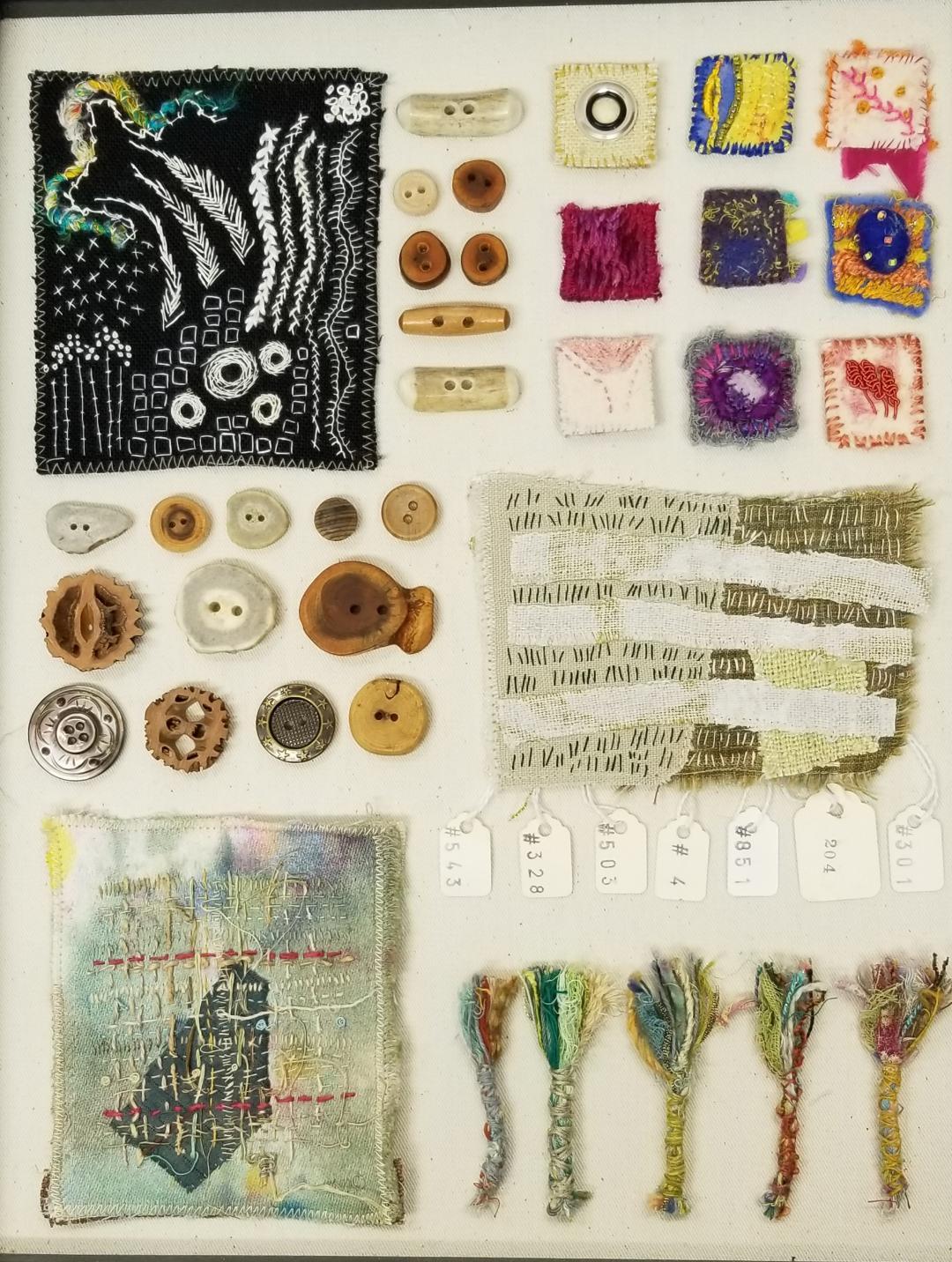
When I began putting the pieces together, I realized I had not kept up with things I had been making in an organized way, so the next job was to plunder drawers and boxes until I could collect everything in one place. When I did, the pieces began to talk to me, to need moving to be with others of that color or design or simply to improve the look. I saw patterns emerge, saw several ways of working that were new, even a return to using buttons. Oh, my gosh, but there is power in putting together a collection!
Below is a part of that body of work. The idea was to simply explore, to start thinking about stitch possibilities, to use the materials to follow up on sketchbook ideas or to work intuitively. Sometimes the intuitive work generated sketchbook activity that led to other pieces. There were no rules except what I might set for myself from day-to-day.
But first, these three pockets were made for a vest that I cobbled together from previously worn garments. It is pieced from different textures of light brown linen, and it needed some splashes of color.

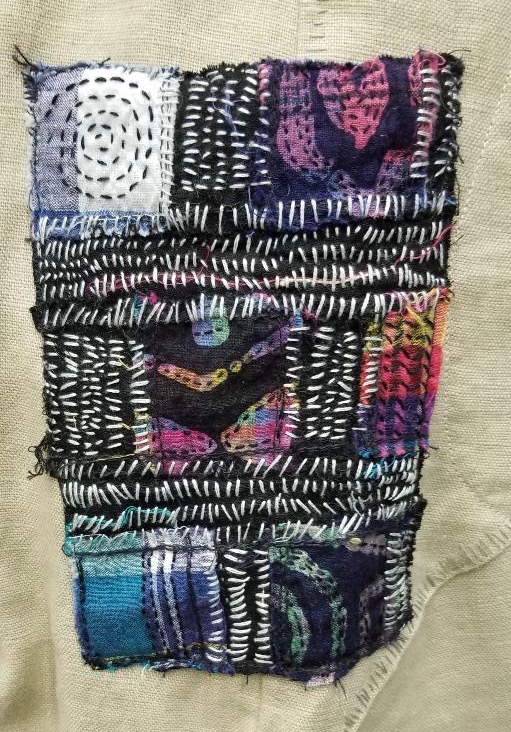

It was interesting to make these pieces, but I did not plan for laundering, so we will see if this goes to the cleaners and comes back in reasonably recognizable condition.

We had a visit from hurricane Zeta at the end of last month. Our home was fine, but the studio, only a few yards away and attached to the house by a fence and gate, were hit by a tree that was twisted off its thick trunk to fall across the roof and skylights.

The tree punched a hole in the roof.

My son, who had a half-dozen very large trees uprooted at his home, only a few miles away, came to cut the tree away from the roof and cover the hole with the ubiquitous blue tarp.

Life at Studio 508 has been muted since "The Fall." The interior suffered light damage, but the impact must have been really startling to the inanimate objects beneath the ceiling. In my line of DMC thread boxes, threads were shifted about an inch to the right, or toward the front of the building, and books on the back wall of book shelves moved forward, all following the pattern the shock waves must have made through the little building. We have waited for these past weeks for insurance response, and we hope for the repairs to begin on Monday.
Add to the studio blues: this all happened just before Halloween, on a Wednesday night, and we were without power until Sunday morning.
In this time I have learned how important it is to understand the way we work, to know what physical accommodations we need to make for giving ourselves a space to create. I need a lot of light that must not be from the front because the glare blinds me. And a table is a must, a large, clear space. Finding the right threads is a matter of having selections fanned out around me, or available just behind my chair so I can turn to make selections. Of course, none of that was been possible in our home without power. Even after power was restored, I stopped bringing in bowls of threads and fabrics from the studio since projects can't be accomplished in the house space.
Fingers crossed for commencement of work on Monday, and a prayer of thanksgiving for people who want to work and help to fix our small mess. And, as Thanksgiving week begins on Monday, how appropriate is that?


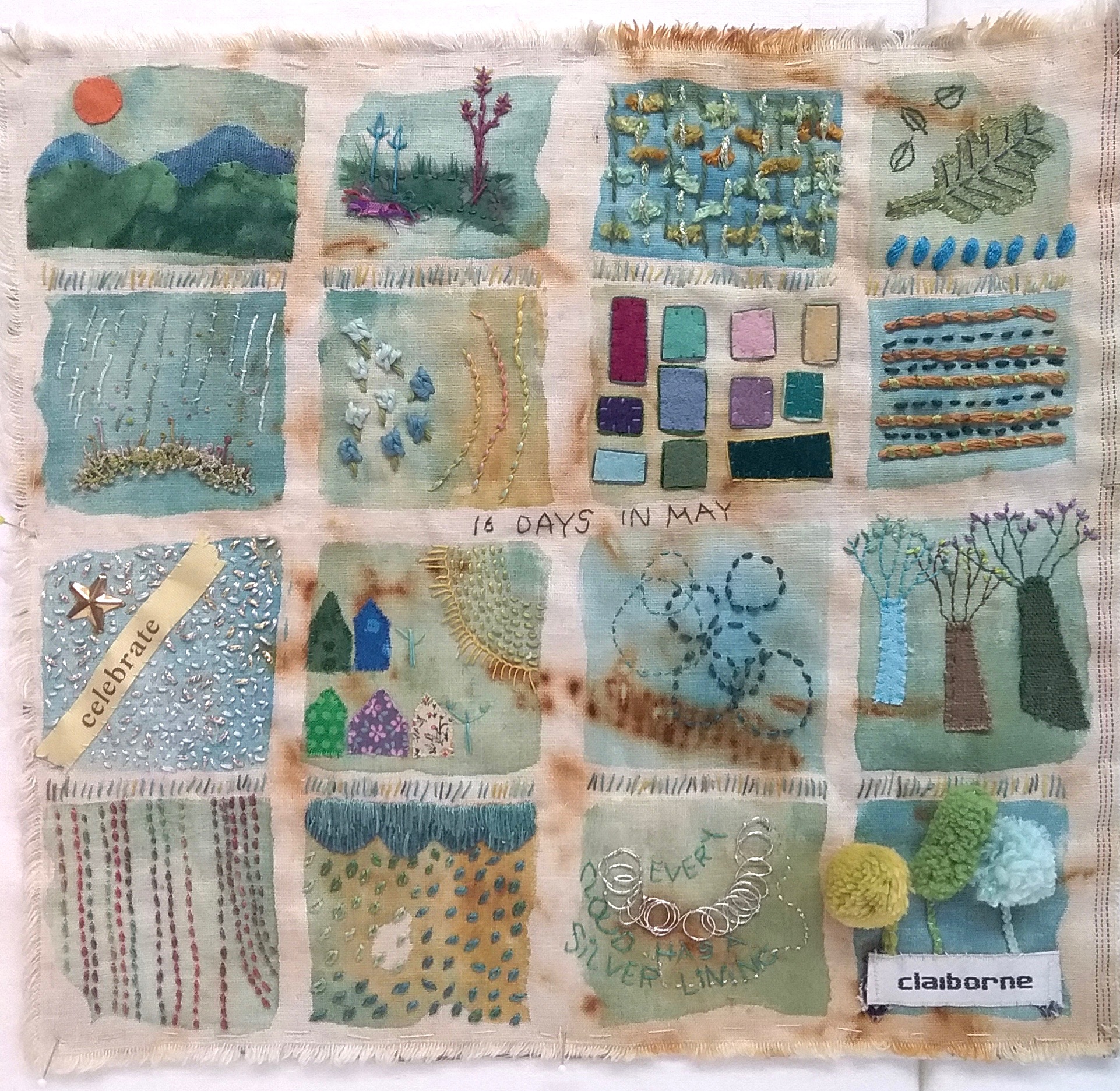


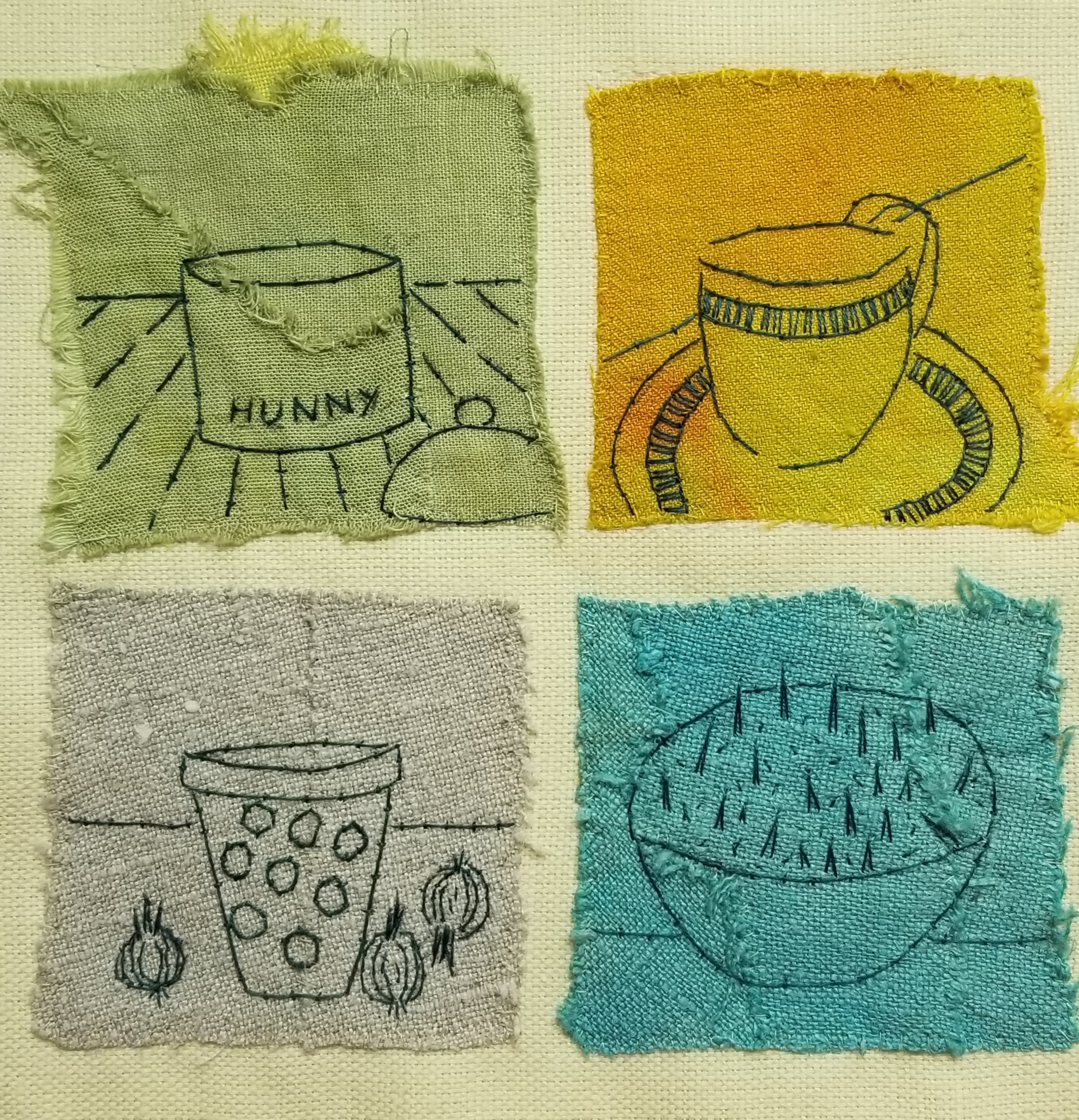




This gap in blogging should be thought of as a hiatus: a pause or gap in a sequence, series or process. So, with tea and a crumbly scone, I am re-entering my blog space. Hiatus is over.
The Quarantine/Lockdown/Shutdown requires me to stay in place, so I use what is at hand in the studio. I am grateful for family, my daughter-in-law, a nurse, and my son, who has demanded that he get our groceries for us. Two amazing humans than I am so proud to know.
The time has been interesting as a type of time, no pre-arranged schedules, no deadlines or string attached to any choices. In fact, very few choices are available now. With no prompting, I become studio-bound every morning.
I began to self-isolate several days in advance of the lockdown, so I am at day 49 with the quarantine. So many other people have commented eloquently on the effects of self-isolation that I will say only that it was easy for a while, but as the days became a month and no end in sight, I become anxious. Creating new work is not as easy as it was two months ago.
Which makes this new piece as welcoming as a wide smile. The bits and bobs are layered together with bright stitches pulled from a bowl spilling over with different types of thread: linen, cotton, silk, rayon, metallic, even some with seemingly spurious origins. Though it is difficult to see in a photograph, the various threads give the rough linen ground a very appealing tactility.

In the studio I have pinned the piece to a board so it greets me each morning. Outside the window, trees that were bare when I started this are quite full now, some with blossoms barely holding to branches as the new leaves push their way into the scented air.
UPDATE: This little piece was included in the "Piece By Piece" late summer issue of Uppercase Magazine. Beyond delighted, the piece is in good company. The issue is devoted to works that are made from scraps or that are pieced together from things that might otherwise have been thrown away. A photo from the magazine:


